Spruce Lake
Train DreamsSpruce Lake is a remote mountain lake reached by Robert Grainier during a crisis of desire and self-condemnation. Hidden behind cliffs and approached by a back way, it receives him at the farthest point of an exhausting journey and transforms an inward struggle into an encounter with immense, still landscape. The lake’s decisive significance is not merely scenic: its distance, darkness, and surrounding mountains give Grainier a temporary release from the “contagion” he fears within himself.
Setting and Approach
Grainier reaches Spruce Lake only after abandoning his cabin and walking for hours. After collapsing behind the cabin on the brown grass, he loses touch with the world until the sun rises over the house and heat itches in his hair. He then dresses, sets out toward the road and Placer Creek, continues for several miles without stopping, climbs Deer Ridge, descends the opposite side, and climbs again into Canuck Basin. The lake is therefore the terminus of a physically punishing passage through the forested country rather than an accessible place of ordinary recreation.
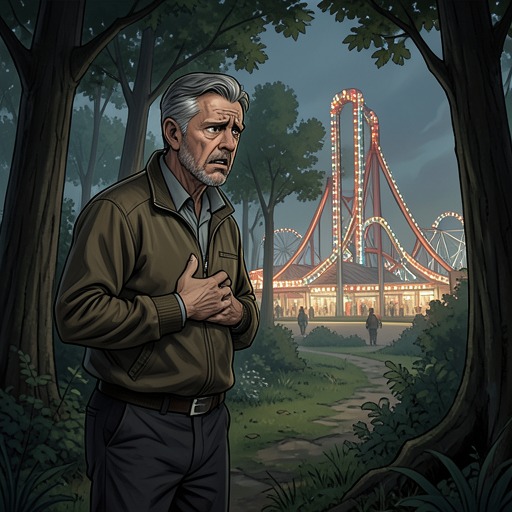
At sunset, his progress ends on a cliff above the lake. He has discovered a hidden route into an arena-like enclosure, with the water hundreds of feet below. From that height, Spruce Lake appears flat and black as obsidian, held in the shadow of the surrounding cliffs and encircled by two rings of evergreens and their reflections. The description gives the place a contained, almost ceremonial form: a basin within the wilderness, separated from the roads and settlements through which Grainier usually moves.
The Lake as a Moment of Release
The sight of Spruce Lake changes the emotional direction of Grainier’s journey. He has spent the walk repeating the word “Pulchritude!” and imagining beauty as a damning force that might reduce him to an animal, snarfing at it or rolling in it like a dog at a carcass. The lake does not answer this fear through argument or social judgment. Instead, its stillness and scale displace the obsession. As he looks beyond the dark water, he sees the Canadian Rockies still lit by the sun, snow-peaked and a hundred miles away, seeming to take their substance from the clouds while the earth is still being created.
This prospect gives Grainier a new relation to distance. The forests that normally fill his life are so tall and dense that they conceal how far away the world is; at Spruce Lake, by contrast, he sees a landscape spacious enough for everyone to possess mountains of their own. The thought marks a decisive expansion of perception. His desire has been claustrophobic, concentrated, and self-accusing, while the lake opens onto a world whose grandeur exceeds private appetite. The narrative explicitly registers the reversal: the curse leaves him, and the contagion of lust seems to drift away into one of the distant valleys.
Night at the Lakeside
Grainier descends carefully among the boulders and reaches the lakeside after darkness has fallen. There he makes a blanket from spruce boughs and a bed from spruce, curls beneath it, and sleeps exhausted but comfortable. The act is materially modest, yet it completes the lake’s function as shelter. Spruce Lake offers no human institution, conversation, or formal absolution; its refuge consists of stone, trees, darkness, and rest.
His retreat also has a cost in ordinary social time. That night he misses the display of pulchritude at the Rex and never learns whether he has saved himself or merely deprived himself. The uncertainty prevents the episode from becoming a simple triumph. Spruce Lake provides a temporary suspension of the crisis, but it does not produce a final explanation of desire or establish a permanent cure. Its value lies in interruption: the obsessive circuit is broken long enough for Grainier to sleep and return.
Narrative Significance
Spruce Lake functions as a natural threshold between psychic confinement and renewed participation in daily life. Grainier arrives after surrendering to exhaustion and leaves without any spoken resolution, suggesting that the landscape itself performs the work that neither self-reproach nor social spectacle can accomplish. The lake is both intensely particular—a black surface, cliff-shadow, reflected evergreens, and distant snow peaks—and symbolically expansive, enlarging Grainier’s world beyond the immediate forests that have defined it.
The return is gradual rather than heroic. Grainier remains at home for two weeks after the journey, then goes back to town and finally gets a large male sledding dog, which becomes his friend for many years. Spruce Lake thus stands within a wider pattern of retreat followed by re-entry: isolation does not erase his ordinary life, but gives him enough distance to resume it. Its lasting importance is the brief restoration of proportion through wilderness, where a private torment becomes small before a landscape “grand” enough to contain more than one person’s fear or desire.